
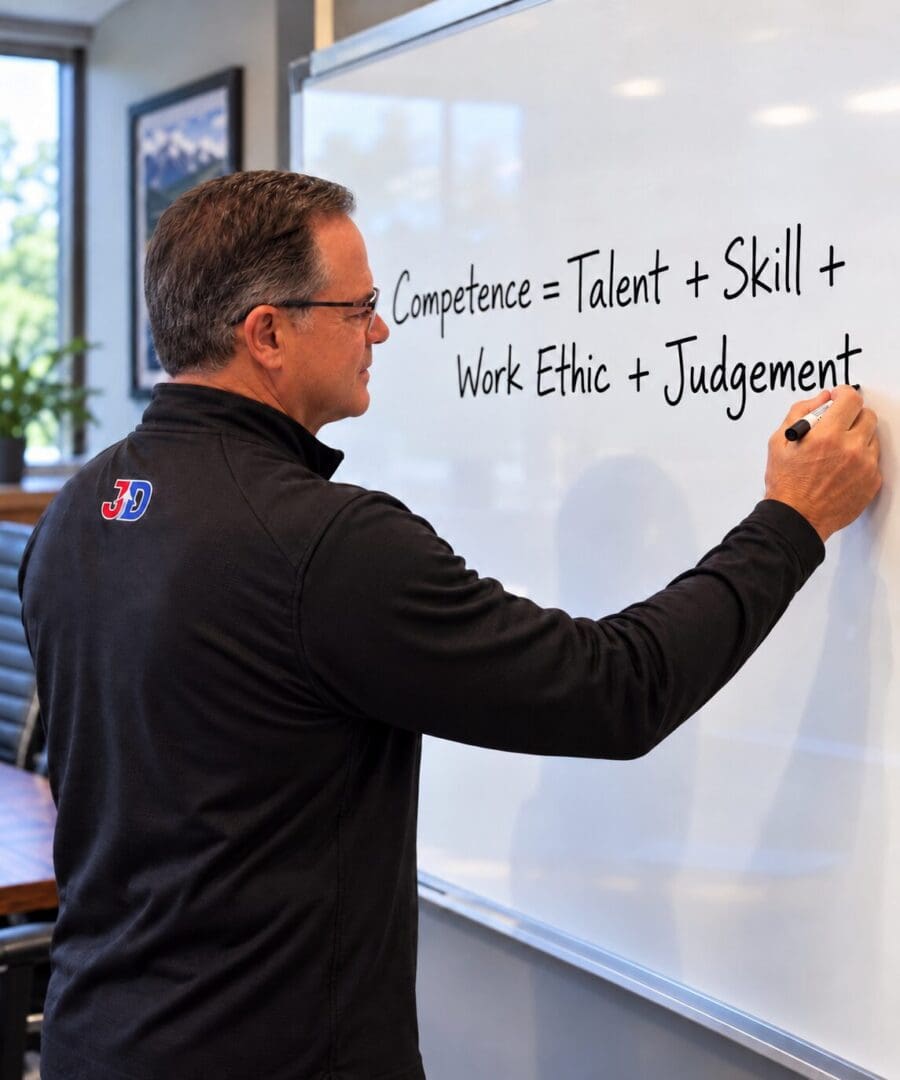
Competence
The first of the Seven Cs of Team Building is Competence.
At first, I thought competence could be defined simply as:
Talent + Work Ethic.
But that is incomplete.
A better definition is:
Competence = Talent + Skill + Work Ethic + Judgment.
You need all four.
Talent gives you potential.
Skill gives you capability.
Work Ethic gives you consistency.
Judgment tells you how and when to apply what you know.
That is competence.
And for leaders trying to build strong teams, it is one of the first things we need to identify, develop, and continually cultivate.
Start With Talent
Talent matters.
People are different.
Some process information faster. Some communicate better. Some are more analytical. Some have better instincts with people. Others have exceptional technical ability, creativity, spatial awareness, or mechanical aptitude.
Great leaders learn to recognize those differences.
That is part of getting the right people in the right seats.
But talent is only potential.
Potential alone does not produce results.
Talent has to be developed.
Learn to Recognize Raw Talent
One of the most important things a leader can learn to do is identify raw talent.
Raw talent is not yet competence.
Someone with raw talent may have very little experience. They may not yet possess the technical skills the job requires. They may never have been placed in a situation requiring significant business judgment.
But something is there.
Maybe they have a history of academic success.
Maybe they have excelled in athletics, the military, another profession, or some completely different field.
Maybe they learn unusually quickly.
Maybe they ask great questions or solve problems differently.
And critically, they have demonstrated a work ethic.
Some of the best people I have hired did not arrive with years of directly relevant experience. What they had was intelligence, ability, drive, and a track record suggesting that when given an opportunity, they would figure things out.
They had raw talent.
The leader’s challenge is to see what someone could become, not simply what they have already done.
But there is an important balance.
You should be willing to sprinkle raw talent into a team, not build the entire team with it.
Raw talent needs experienced people around it—people who already possess the skills, judgment, and pattern recognition that come only from having been through difficult situations before.
A strong team needs both.
It needs proven performers who can execute today and high-potential people who can become tomorrow’s proven performers.
Experience matters, but it is only one indicator of future competence.
Sometimes the person with ten years of experience has simply repeated the same year ten times.
Meanwhile, the person with limited experience but exceptional raw talent and work ethic may have a much steeper development curve.
That is where leadership matters.
Identify the raw talent.
Surround it with experience.
Then develop it.
Master the Basics
Every career field has elementary requirements—the Basics.
A quarterback has footwork and throwing mechanics.
A golfer has grip, stance, and alignment.
An accountant has debits and credits.
An engineer has mathematics.
A salesperson has to understand the customer, the product, and the value proposition.
Whatever your profession, there are fundamental skills and knowledge that you simply must master.
There are no shortcuts.
The problem is that the Basics can become boring.
Once people experience some success, they often want to move beyond them. They want bigger responsibilities, more strategic assignments, and more interesting work.
But elite performers never graduate from the fundamentals.
Watch a professional athlete practice. Much of what they do would look familiar to someone just learning the sport. The difference is the precision and consistency with which they execute those basics.
Advanced performance is built on foundational skill.
You cannot skip the Basics because they seem beneath you.
Competence builds on itself.
Skill Has to Be Developed
Talent tells you what someone may be capable of.
Skill tells you what they can actually do.
Skill is developed through learning, repetition, coaching, experience, and practice.
A naturally talented person may initially outperform someone with less natural ability.
But over time, the person who studies the craft, seeks feedback, practices deliberately, and continues learning will often pass the person who simply relies on talent.
Leaders should not only ask:
“Is this person talented?”
They should also ask:
“What have they done with that talent?”
Talent may open the door.
Skill determines whether you can perform once you walk through it.
Work Ethic Makes Competence Dependable
Even talent and skill are not enough.
Competence requires work ethic.
I have seen tremendously talented people underperform because they relied too heavily on natural ability.
At first, they could get away with it.
Then the assignments became harder.
The competition improved.
The responsibility increased.
Eventually, natural ability was not enough.
Competent people do the work.
They prepare.
They practice.
They study.
They ask questions.
They seek feedback.
They correct mistakes.
They keep improving.
Talent can produce flashes of excellence. Work ethic turns excellence into a habit.
Judgment Separates Good From Great
The final component may become the most important as responsibility increases.
Judgment.
You can have talent.
You can master the skills.
You can work harder than everyone around you.
And you can still make poor decisions.
Competence is not simply knowing what to do.
It is knowing when to do it, how to do it, and sometimes knowing when not to do it at all.
Judgment develops through experience, reflection, failure, coaching, and exposure to difficult situations.
That is especially important when developing someone with raw talent.
You should not expect an inexperienced person to possess judgment they have never had the opportunity to develop.
They need exposure.
They need increasingly difficult assignments.
They need opportunities to make decisions.
And they need leaders who will coach them through the consequences.
Early in a career, someone may be evaluated primarily on execution.
Later, they are evaluated on decisions.
The question changes from:
“Can you do the work?”
to:
“Can I trust you to determine what work needs to be done?”
That is a higher level of competence.
Competence Is Never Finished
One of the dangers of becoming good at something is believing you have arrived.
Industries change.
Technology changes.
Customers change.
Expectations change.
The most competent people I know remain curious and teachable.
They keep sharpening their skills.
They stay close to the Basics.
They ask for feedback.
They take on new challenges.
And they continue developing their judgment.
Competence is not a destination.
It has to be continually maintained and strengthened.
JD3 Leadership Takeaway
Competence = Talent + Skill + Work Ethic + Judgment.
As leaders, we need to evaluate all four.
Sometimes we are hiring proven competence.
Other times, we are hiring raw talent with the capacity to become competent.
When interviewing someone, here are three questions worth asking:
1. “What are the fundamentals of your profession that someone absolutely must master to be excellent at it?”
A competent person should be able to articulate the Basics of their craft.
A useful follow-up is:
“Which of those fundamentals did you have to work hardest to develop?”
That begins to reveal work ethic and self-awareness.
2. “Tell me about a difficult professional decision you had to make when the answer was not obvious. How did you decide what to do?”
This begins to reveal judgment.
Listen not only for the outcome, but for the thinking behind it.
3. “What are you working on right now to become better at what you do?”
This tells you whether continued development is part of the person’s normal behavior.
Competent people rarely believe their development is finished.
So when evaluating competence, ask yourself:
Is the talent there?
Have they developed the necessary skills—or do they have the ability and work ethic to develop them?
Do they have the work ethic to perform consistently?
Do they have the judgment the role requires—or can I give them the experiences necessary to develop it?
Find the talent.
Teach the skills.
Demand the work.
Develop the judgment.
Then keep raising the standard.
Because great teams are not built simply with experienced people.
And they are not built simply with talented people.
They are built by leaders who can recognize competence when they see it—and recognize raw talent before everyone else does.
Lead with Integrity. Serve with Humility. Develop People Relentlessly.