
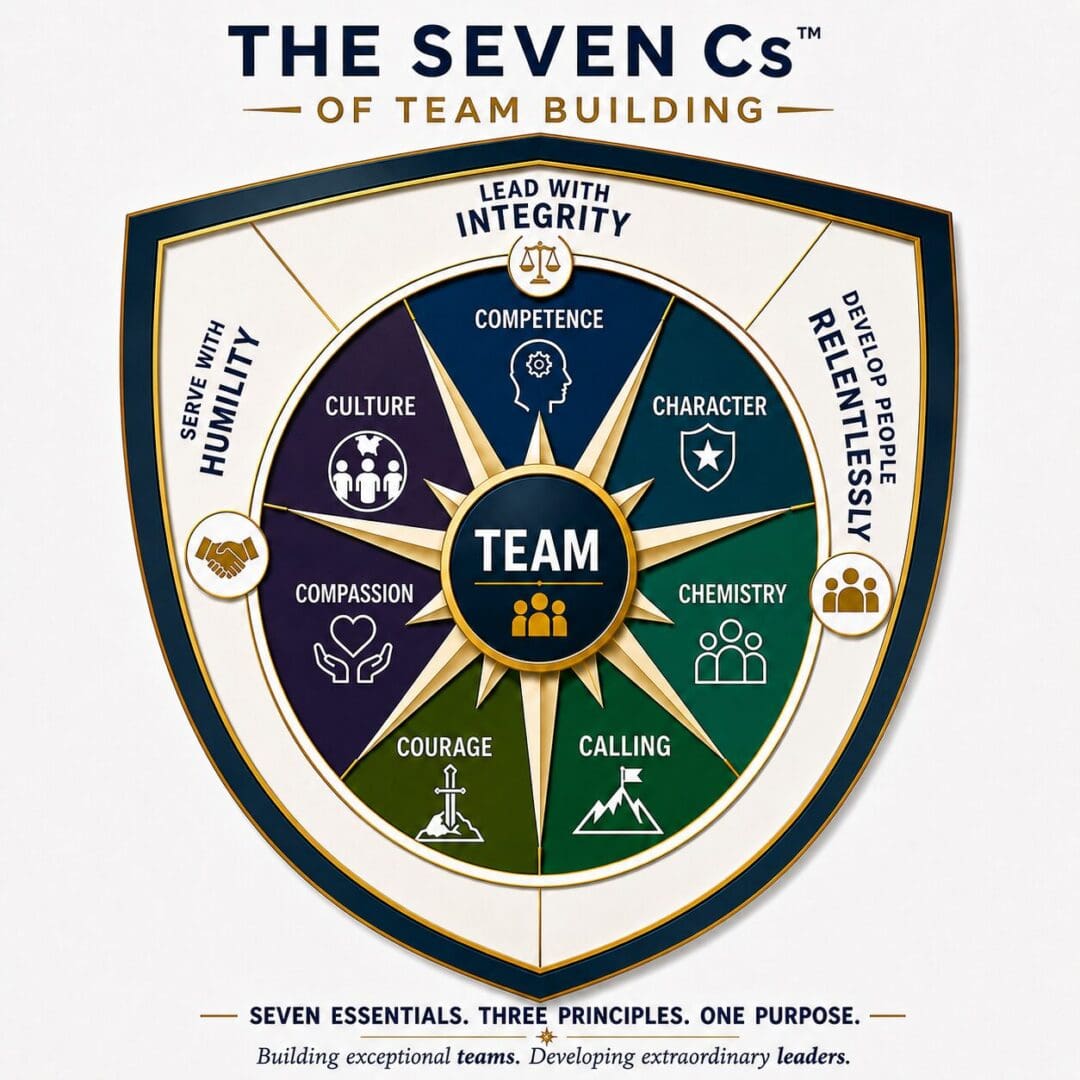
The Seven Cs of Team Building
This week’s JD3-Minute Leadership introduces The Seven Cs of Team Building—the leadership philosophy I’ve developed over nearly three decades of building, leading, and developing teams.
Because we’re introducing all Seven Cs at once, this week’s blog is a little longer than our usual three-minute read. I hope you don’t mind.
Over the coming months, we’ll take a deeper look at each of the Seven Cs individually.
Consider this the beginning of the journey. Here we go!
The Seven Cs of Team Building
Great teams don’t happen by accident. They are built—one person, one decision, and one leadership choice at a time.
I’ve spent much of my career building teams.
Some were small. Some numbered in the hundreds. Some were formed to tackle opportunities that had never been attempted before. Others had to perform under enormous pressure, when the stakes were high and the margin for error was small.
Along the way, I’ve hired some great people.
I’ve also hired some people who looked great on paper but didn’t work out.
I’ve inherited teams. Rebuilt teams. Combined teams. Watched teams exceed expectations. And watched talented groups of individuals struggle because they never really became a team.
Through all of it, I became convinced of one thing:
Great teams are intentionally built.
And over time, I began to recognize seven characteristics that consistently showed up in the strongest teams I had the privilege to lead.
I call them The Seven Cs of Team Building. They have become the cornerstone of how I lead. I’m introducing the framework here, and over the coming months, we’ll take a closer look at each “C” and what it means for building great teams.
1. Competence — Can they do the job?
Let’s start with the obvious one.
Talent matters.
You can hire wonderful people with great attitudes, but if they cannot perform the work required of them, the team will eventually struggle.
Competence isn’t about knowing everything on Day One. Some of the best people I ever hired had little or no experience in our industry when they joined us.
But they could learn, and they demonstrated that attribute from the moment I first interacted with them. We call that “raw talent.”
They were smart. Curious. Coachable. Disciplined. They absorbed information quickly and got better.
That distinction matters.
When I evaluate competence, I’m not only asking:
What can this person do today?
I’m also asking:
What could this person become?
The best teams are filled with people who are capable—and committed to becoming even more capable tomorrow.
2. Character — Can you trust them?
If competence gets someone on the team, character determines whether I want them there for the long haul.
Skills can be developed.
Character is much harder to repair.
When pressure rises, deadlines slip, money is involved, or something goes wrong, character gets exposed.
Do they tell the truth?
Do they accept responsibility?
Do they honor their commitments?
Do they do the right thing when doing the right thing costs them something?
You can build around a competence gap.
It is extraordinarily difficult to build around a character gap.
Competence may earn respect. Character earns trust.
And no team can become great without trust.
3. Chemistry — Do they make the team better?
I’ve interviewed plenty of highly qualified people who I knew within thirty minutes I didn’t want on my team.
Why?
Chemistry.
Not because everyone needs to think alike. In fact, great teams need different personalities, experiences, perspectives, and ways of thinking.
Chemistry is something different.
It is the ability to work together—and to make the people around you better.
I think about it in terms of catalysts and inhibitors.
In chemistry, a catalyst accelerates a reaction. It helps things happen faster and more effectively. An inhibitor does the opposite. It slows the reaction down or prevents it from happening at all.
Teams have catalysts and inhibitors too.
Catalysts create energy. They build trust. They connect people. They move conversations forward. They make others better.
Inhibitors drain energy. They create friction. They slow decisions, undermine trust, and make collaboration harder than it needs to be.
That’s why I don’t evaluate Chemistry by asking whether I personally like someone. I ask a much more important question:
What happens to the team when this person enters the room?
Listen carefully to the pronouns people use.
Do you hear:
I. Me. Mine.
Or:
We. Us. Ours.
Great teammates don’t need to be the hero of every story. They make the people around them better.
They challenge without dividing. They disagree without becoming disagreeable. They compete for the team—not against it.
Talent can win a game.
Chemistry helps build dynasties.
4. Calling — Is this where they are supposed to be?
This one took me longer to understand.
Someone can be competent, possess great character, and fit beautifully with the team—and still be in the wrong job.
People perform differently when they believe their work matters.
There is a difference between having a job and having a calling.
Calling doesn’t necessarily mean someone has identified one grand purpose for their entire life.
Sometimes calling is much simpler.
It is the intersection of:
What am I good at?
What do I care about?
Where can I contribute?
One of the great responsibilities of leadership is helping people find that intersection.
I’ve watched people struggle in one role and flourish in another—not because they suddenly became smarter, but because they finally found the right seat.
Great leaders don’t just fill positions. They help people discover where they can thrive.
5. Courage — Will they act when it would be easier not to?
Organizations rarely suffer from a shortage of people who know what should be done.
They often suffer from a shortage of people willing to do it.
That’s courage.
Courage is having the difficult conversation.
Challenging an idea when everyone else is nodding.
Admitting you made the mistake.
Making an unpopular decision because it is the right decision.
Giving someone honest feedback.
Defending a teammate.
Standing by your values when compromising them would be easier.
Some of the biggest leadership failures I’ve witnessed weren’t failures of intelligence.
They were failures of courage. (And yes, I am guilty of lacking courage at certain moments of my career. We all are.)
Teams need people willing to speak up, step forward, and act when the moment requires it.
6. Compassion — Do they care about the people around them?
For years, business taught leaders to separate performance from emotion.
Get results.
Hit the number.
Make the deadline.
Hold people accountable.
All of those things matter.
But the people producing those results are still people.
They have families. Fears. Struggles. Disappointments. Dreams. Bad days. And moments when life hits them hard.
Compassion doesn’t mean lowering standards.
It doesn’t mean avoiding accountability.
Some of the most compassionate conversations a leader can have are also some of the most difficult.
Compassion simply means remembering that there is a human being on the other side of the conversation.
The best leaders hold people accountable without losing sight of the person they are holding accountable.
7. Culture — What happens when all the other Cs come together?
Culture is the final C for a reason.
In many ways, it is the culmination of the first six.
Put competent people of character together.
Build chemistry among them.
Help them discover their calling.
Help them find the courage to speak and act.
Encourage them to treat one another with compassion.
Do those things consistently, and something powerful begins to emerge:
Culture. And not just any culture—a healthy culture built on trust, performance and sacrifice for the greater good of the organization.
Culture isn’t the values printed on the wall.
It isn’t the employee handbook.
It isn’t what the CEO says at the annual meeting.
Culture is how people actually behave when nobody is reminding them how they’re supposed to behave.
It’s what leaders reward.
It’s what leaders tolerate.
It’s what leaders model.
And once established, culture becomes incredibly powerful.
A strong culture attracts the right people, develops them, holds them accountable, and gives them a place where they want to stay.
A weak culture eventually drives the best people away.
Seven Cs. One Team.
Here’s what I’ve learned after decades of leadership:
You cannot build a great team by optimizing for just one of these characteristics.
Competence without Character can be dangerous.
Character without Competence isn’t enough.
Competence and Character without Chemistry can create dysfunction.
Chemistry without Courage can create artificial harmony.
Courage without Compassion can become cruelty.
Calling without the others can become frustration.
And Culture doesn’t become healthy because a leader declares it healthy.
Culture is the result of everything that came before it.
That’s why I think of the Seven Cs as a system rather than a checklist.
Competence.
Character.
Chemistry.
Calling.
Courage.
Compassion.
Culture.
I’ve spent a career learning these lessons—sometimes because we got them right and sometimes because we didn’t.
And perhaps the most rewarding evidence I’ve ever seen came on one remarkable day when four people who began working for me with little or no industry experience were promoted to Vice President after years of modeling the Seven Cs—on the same day!
Their promotions weren’t my accomplishments.
They were theirs.
But watching them succeed provided the best moment of my career and reminded me what leadership is ultimately about.
The best measure of a leader isn’t how far the leader advances.
It’s what happens to the people around them.
Build them.
Challenge them.
Believe in them.
Give them opportunities.
And create an environment where they can become more than they were when they arrived.
That’s how you build great teams.
And that’s how you build a legacy.
JD3 Leadership Takeaway
Don’t ask only whether you have talented people.
Ask seven questions:
Are they Competent?
Do they have Character?
Do they create Chemistry?
Have they found their Calling?
Will they demonstrate Courage?
Do they lead with Compassion?
And what kind of Culture are all of those things creating?
Because great teams don’t happen by accident.
They are built.
Lead with Integrity. Serve with Humility. Develop People Relentlessly.This week’s JD3-Minute Leadership introduces The Seven Cs of Team Building—the leadership philosophy I’ve developed over nearly three decades of building, leading, and developing teams.
Because we’re introducing all Seven Cs at once, this week’s blog is a little longer than our usual three-minute read. I hope you don’t mind.
Over the coming months, we’ll take a deeper look at each of the Seven Cs individually.
Consider this the beginning of the journey. Here we go!
The Seven Cs of Team Building
Great teams don’t happen by accident. They are built—one person, one decision, and one leadership choice at a time.
I’ve spent much of my career building teams.
Some were small. Some numbered in the hundreds. Some were formed to tackle opportunities that had never been attempted before. Others had to perform under enormous pressure, when the stakes were high and the margin for error was small.
Along the way, I’ve hired some great people.
I’ve also hired some people who looked great on paper but didn’t work out.
I’ve inherited teams. Rebuilt teams. Combined teams. Watched teams exceed expectations. And watched talented groups of individuals struggle because they never really became a team.
Through all of it, I became convinced of one thing:
Great teams are intentionally built.
And over time, I began to recognize seven characteristics that consistently showed up in the strongest teams I had the privilege to lead.
I call them The Seven Cs of Team Building. They have become the cornerstone of how I lead. I’m introducing the framework here, and over the coming months, we’ll take a closer look at each “C” and what it means for building great teams.
1. Competence — Can they do the job?
Let’s start with the obvious one.
Talent matters.
You can hire wonderful people with great attitudes, but if they cannot perform the work required of them, the team will eventually struggle.
Competence isn’t about knowing everything on Day One. Some of the best people I ever hired had little or no experience in our industry when they joined us.
But they could learn, and they demonstrated that attribute from the moment I first interacted with them. We call that “raw talent.”
They were smart. Curious. Coachable. Disciplined. They absorbed information quickly and got better.
That distinction matters.
When I evaluate competence, I’m not only asking:
What can this person do today?
I’m also asking:
What could this person become?
The best teams are filled with people who are capable—and committed to becoming even more capable tomorrow.
2. Character — Can you trust them?
If competence gets someone on the team, character determines whether I want them there for the long haul.
Skills can be developed.
Character is much harder to repair.
When pressure rises, deadlines slip, money is involved, or something goes wrong, character gets exposed.
Do they tell the truth?
Do they accept responsibility?
Do they honor their commitments?
Do they do the right thing when doing the right thing costs them something?
You can build around a competence gap.
It is extraordinarily difficult to build around a character gap.
Competence may earn respect. Character earns trust.
And no team can become great without trust.
3. Chemistry — Do they make the team better?
I’ve interviewed plenty of highly qualified people who I knew within thirty minutes I didn’t want on my team.
Why?
Chemistry.
Not because everyone needs to think alike. In fact, great teams need different personalities, experiences, perspectives, and ways of thinking.
Chemistry is something different.
It is the ability to work together—and to make the people around you better.
I think about it in terms of catalysts and inhibitors.
In chemistry, a catalyst accelerates a reaction. It helps things happen faster and more effectively. An inhibitor does the opposite. It slows the reaction down or prevents it from happening at all.
Teams have catalysts and inhibitors too.
Catalysts create energy. They build trust. They connect people. They move conversations forward. They make others better.
Inhibitors drain energy. They create friction. They slow decisions, undermine trust, and make collaboration harder than it needs to be.
That’s why I don’t evaluate Chemistry by asking whether I personally like someone. I ask a much more important question:
What happens to the team when this person enters the room?
Listen carefully to the pronouns people use.
Do you hear:
I. Me. Mine.
Or:
We. Us. Ours.
Great teammates don’t need to be the hero of every story. They make the people around them better.
They challenge without dividing. They disagree without becoming disagreeable. They compete for the team—not against it.
Talent can win a game.
Chemistry helps build dynasties.
4. Calling — Is this where they are supposed to be?
This one took me longer to understand.
Someone can be competent, possess great character, and fit beautifully with the team—and still be in the wrong job.
People perform differently when they believe their work matters.
There is a difference between having a job and having a calling.
Calling doesn’t necessarily mean someone has identified one grand purpose for their entire life.
Sometimes calling is much simpler.
It is the intersection of:
What am I good at?
What do I care about?
Where can I contribute?
One of the great responsibilities of leadership is helping people find that intersection.
I’ve watched people struggle in one role and flourish in another—not because they suddenly became smarter, but because they finally found the right seat.
Great leaders don’t just fill positions. They help people discover where they can thrive.
5. Courage — Will they act when it would be easier not to?
Organizations rarely suffer from a shortage of people who know what should be done.
They often suffer from a shortage of people willing to do it.
That’s courage.
Courage is having the difficult conversation.
Challenging an idea when everyone else is nodding.
Admitting you made the mistake.
Making an unpopular decision because it is the right decision.
Giving someone honest feedback.
Defending a teammate.
Standing by your values when compromising them would be easier.
Some of the biggest leadership failures I’ve witnessed weren’t failures of intelligence.
They were failures of courage. (And yes, I am guilty of lacking courage at certain moments of my career. We all are.)
Teams need people willing to speak up, step forward, and act when the moment requires it.
6. Compassion — Do they care about the people around them?
For years, business taught leaders to separate performance from emotion.
Get results.
Hit the number.
Make the deadline.
Hold people accountable.
All of those things matter.
But the people producing those results are still people.
They have families. Fears. Struggles. Disappointments. Dreams. Bad days. And moments when life hits them hard.
Compassion doesn’t mean lowering standards.
It doesn’t mean avoiding accountability.
Some of the most compassionate conversations a leader can have are also some of the most difficult.
Compassion simply means remembering that there is a human being on the other side of the conversation.
The best leaders hold people accountable without losing sight of the person they are holding accountable.
7. Culture — What happens when all the other Cs come together?
Culture is the final C for a reason.
In many ways, it is the culmination of the first six.
Put competent people of character together.
Build chemistry among them.
Help them discover their calling.
Help them find the courage to speak and act.
Encourage them to treat one another with compassion.
Do those things consistently, and something powerful begins to emerge:
Culture. And not just any culture—a healthy culture built on trust, performance and sacrifice for the greater good of the organization.
Culture isn’t the values printed on the wall.
It isn’t the employee handbook.
It isn’t what the CEO says at the annual meeting.
Culture is how people actually behave when nobody is reminding them how they’re supposed to behave.
It’s what leaders reward.
It’s what leaders tolerate.
It’s what leaders model.
And once established, culture becomes incredibly powerful.
A strong culture attracts the right people, develops them, holds them accountable, and gives them a place where they want to stay.
A weak culture eventually drives the best people away.
Seven Cs. One Team.
Here’s what I’ve learned after decades of leadership:
You cannot build a great team by optimizing for just one of these characteristics.
Competence without Character can be dangerous.
Character without Competence isn’t enough.
Competence and Character without Chemistry can create dysfunction.
Chemistry without Courage can create artificial harmony.
Courage without Compassion can become cruelty.
Calling without the others can become frustration.
And Culture doesn’t become healthy because a leader declares it healthy.
Culture is the result of everything that came before it.
That’s why I think of the Seven Cs as a system rather than a checklist.
Competence.
Character.
Chemistry.
Calling.
Courage.
Compassion.
Culture.
I’ve spent a career learning these lessons—sometimes because we got them right and sometimes because we didn’t.
And perhaps the most rewarding evidence I’ve ever seen came on one remarkable day when four people who began working for me with little or no industry experience were promoted to Vice President after years of modeling the Seven Cs—on the same day!
Their promotions weren’t my accomplishments.
They were theirs.
But watching them succeed provided the best moment of my career and reminded me what leadership is ultimately about.
The best measure of a leader isn’t how far the leader advances.
It’s what happens to the people around them.
Build them.
Challenge them.
Believe in them.
Give them opportunities.
And create an environment where they can become more than they were when they arrived.
That’s how you build great teams.
And that’s how you build a legacy.
JD3 Leadership Takeaway
Don’t ask only whether you have talented people.
Ask seven questions:
Are they Competent?
Do they have Character?
Do they create Chemistry?
Have they found their Calling?
Will they demonstrate Courage?
Do they lead with Compassion?
And what kind of Culture are all of those things creating?
Because great teams don’t happen by accident.
They are built.
Lead with Integrity. Serve with Humility. Develop People Relentlessly.